Time and Determinism
Determinism is the idea that reality is causally closed. There are no effects that are not caused within material reality. A chain of cause and effect implies time too. Effects always come after causes. Determinism is thought to be predictable in principle; ie if you know the position and momentum of every particle in reality at one instant then you can predict the future and retrodict the past.
Naive physics presents reality as having 4 dimensions; length, width, height as spatial dimensions with time as a fourth dimension; hence the idea of a 4d spacetime. Spacetime is a funny thing. Each dimension is infinite so spacetime is eternal because the time dimension is infinite.
Naive physics uses time to make predictions. Consider the equation; distance=.5*acceleration*timeinterval^2
It tells how far a thing will move in a time interval given a certain acceleration.
In this equation it doesn't matter if you are looking forward or backward in time - only the magnitude matters.
But that isn't really what our experience of time is like. We can't go back or forward from the moment we are in - we are swept inexorably to the future. One way of describing time is to say that things fall apart eventually. Reality changes from moment to moment. We know that we can't return to the past and the future is unpredictable.
Once that unpredictability was seen as a matter of tractability - we are physically incapable of doing the calculation.
Contemporary physics has changed that perception. I think now that we've found unpredictability in deterministic systems many times. In fact - it seems that predictable systems are the rare case among all the unpredictability.
Physics now has a strange problem. Both quantum mechanics and relativity have been confirmed to great precision but those two systems are incompatible with each other which is a surprise in itself - but also both systems are fundamentally unpredictable.
I've stepped my way through accounts of the math for both systems and am satisfied that they are correct though I can't actually work with that math. I found an easier demonstration of unpredictable deterministic systems - that is, I can write computer programs that produce an unpredictable outcome. Computer programs are completely deterministic.
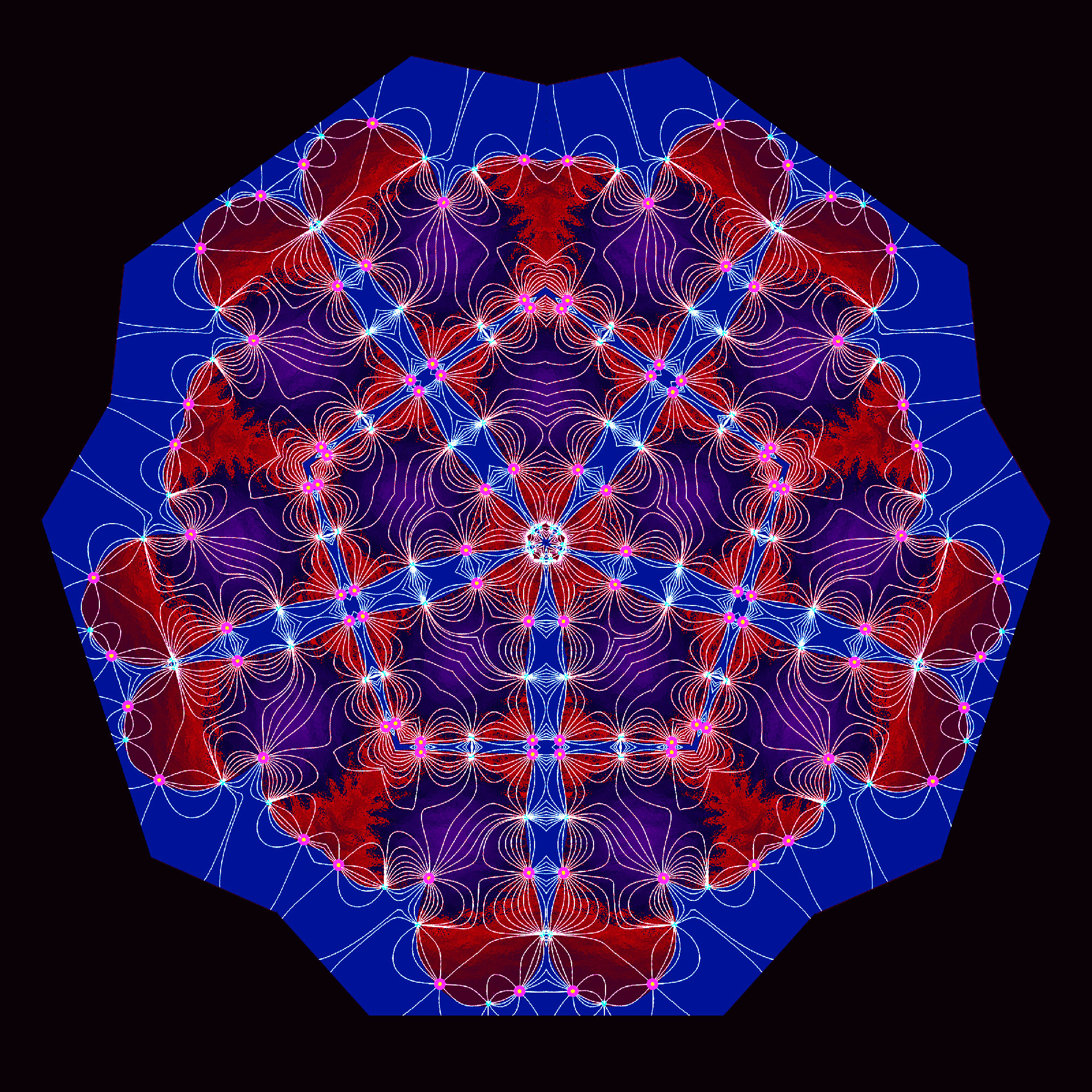
I've found many examples. Fractals are a common example. Lots of fractals are so unpredictable that they aren't always unpredictable - it's what makes them so much fun. One of the pleasures of coding fractals is that you get to watch the image emerge pixel by pixel and one anticipates what the color of the next pixel will be. There are big zones in the image where the emerging pixel is coloured the same way as its neighbors and then there are zones where they are not colored the same way, a kind of random froth. Within the froth there are zones of predictability.
The term fractal means "self similar at all scales". Its seen in the Mandelbrot set. Mandelbrot discovered that an actual coastline demonstrates the same property. If you measure a coastline the size of the ruler you use has a big influence on the length you get.
This fractal property of reality is the space that determinism operates in.
As reality evolves from moment to moment we find that we can look back a certain distance with some reliability and we can look forward with some, though lesser, reliability. I think reality has the same problem in a way.
We tend to think of causality as a chain of cause and effect where each effect becomes the cause of the next effect where each effect becomes the cause of the next effect . . . . .
I think it's more accurate to think in terms of a causal net where each cause has many effects and each effect causes many things.
With cause and effect the nearby causes influence whatever is affected. Once something has been affected some previous causes get too far away to be influential anymore - they fade into the background noise of the causal web.
This matter of being influenced is not just a matter of a creature with perception being influenced - in the broader picture it's more like a compass needle being influenced by a magnet.
What do you think?
I open the floor
 I present regular philosophy discussions in a virtual reality called Second Life.
I set a topic and people come as avatars and sit around a virtual table to discuss it.
Each week I write a short essay to set the topic.
I show a selection of them here.
I present regular philosophy discussions in a virtual reality called Second Life.
I set a topic and people come as avatars and sit around a virtual table to discuss it.
Each week I write a short essay to set the topic.
I show a selection of them here.